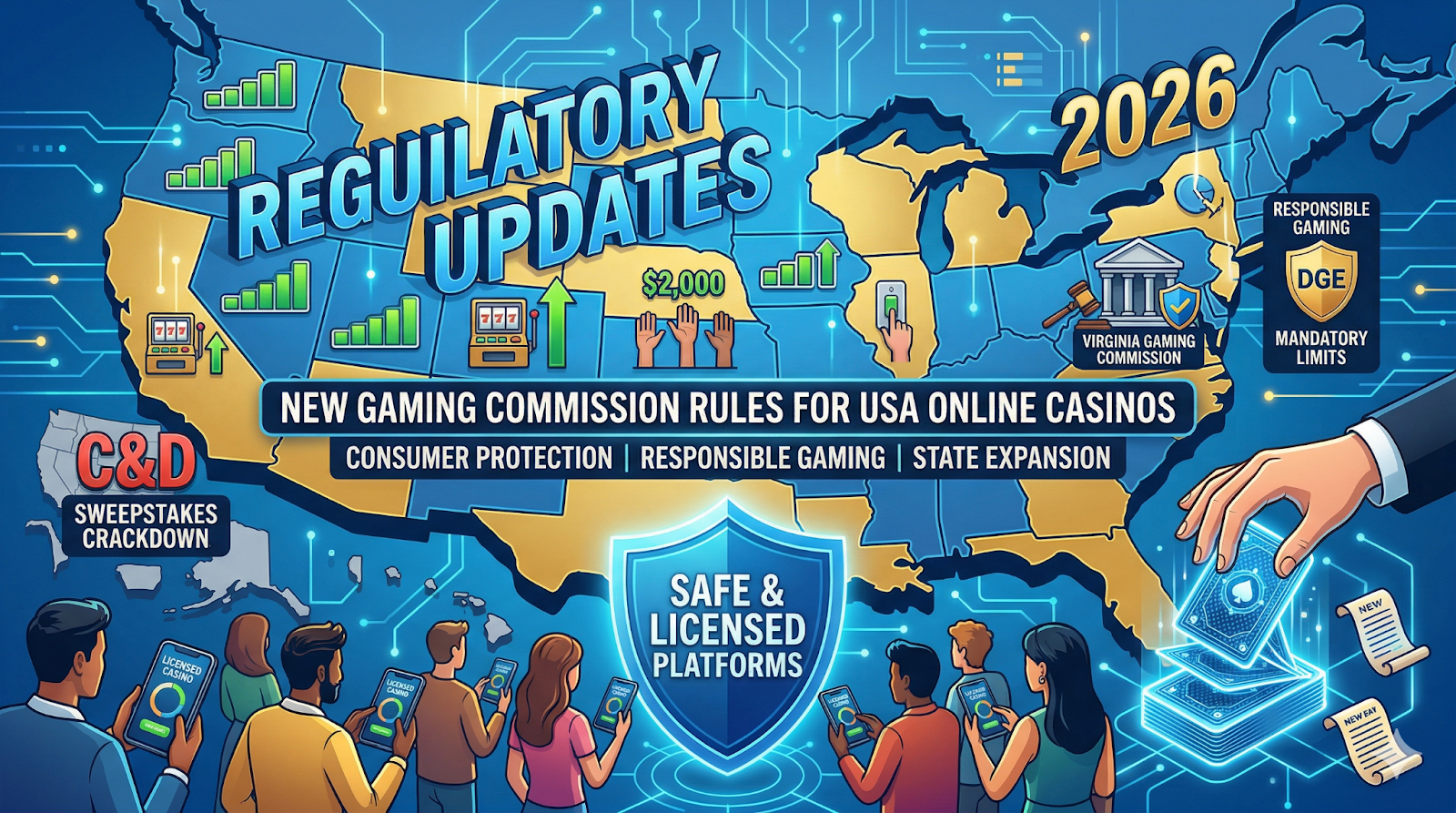
The online gambling landscape in the United States is shifting faster than a dealer shuffling a fresh deck. From sweeping new commission structures in Virginia to tightened consumer protections in New Jersey, 2026 is shaping up to be a landmark year for iGaming regulation. Whether you’re a player looking for safe, licensed platforms or an operator navigating compliance, understanding these regulatory changes is no longer optional — it’s essential.
The Big Picture: A Nation in Regulatory Transition
As of today, six U.S. states have legalized taxed, regulated online casino gambling: New Jersey, Pennsylvania, Michigan, Delaware, West Virginia, and Connecticut. But that map is actively being redrawn.
Multiple states have reintroduced or advanced online casino legislation in early 2026, putting iGaming back on the agenda for bettors and operators alike. Renewed bills and committee movements — particularly in New York, Virginia, and Hawaii, plus Maine’s recently passed tribal measure — signal a renewed push to expand regulated online gambling across the country.
For players, this matters enormously. Expanded online casino gaming means broader access to licensed platforms, stronger consumer protections, and clearer rules around payments and payouts compared to offshore sites. Regulated markets typically require licensing, identity verification, and responsible gaming safeguards — measures that reduce the risks associated with unlicensed operators.
Virginia Creates a Dedicated Gaming Commission
One of the most consequential regulatory developments of the year is happening in Virginia. High-priority legislation — SB195 and SB558 — establishes a dedicated state Gaming Commission to assume regulatory oversight of casinos, sports betting, and horse racing from the Virginia Lottery.
Advocates for online casinos in Virginia are likely to wait until this Gaming Commission is fully operational before advancing iGaming proposals, making 2026 a key year for setting the regulatory framework that could allow online casino gaming to launch in the state. The full framework is expected to be implemented by January 1, 2028.
This is a textbook example of states doing the groundwork right — building the regulatory infrastructure before opening the floodgates to operators. Players in Virginia should watch this space closely; a well-governed market will ultimately mean safer, fairer, and more trustworthy platforms.
New Consumer Protection Rules Are Getting Teeth
Across already-regulated states, commissions are tightening the rules — and the focus is squarely on protecting players.
New Jersey has put forth proposed changes to Division of Gaming Enforcement regulations requiring both sportsbooks and online casino operators to provide customers with a mandatory prompt for a minimum deposit limit upon creating a new account — not merely as an optional feature. Michigan is reviewing its internet gaming regulations to increase requirements related to “reality checks” and session time reminders for players.
These aren’t cosmetic changes. Mandatory deposit limits at account creation represent a fundamental philosophical shift: instead of burying responsible gambling tools in settings menus, regulators are demanding they be front and center from day one.
At the national level, 29 jurisdictions with account-based online gaming now require operators to provide mechanisms through which players may self-limit deposits, losses, wagering amounts, and time spent gambling. Additionally, all 38 jurisdictions with regulated gaming require operators to adopt self-exclusion programs, enabling patrons to exclude themselves from casino or online gaming sites.
For players choosing among the best online casinos USA, these consumer protection standards are a critical benchmark — any reputable licensed platform operating in 2026 should offer all of these tools as baseline features, not optional extras.
The Sweepstakes Casino Crackdown
Perhaps the most dramatic regulatory story of 2026 is the accelerating clampdown on sweepstakes casinos — platforms that operate in a legal gray zone by offering free-to-play games with prize redemption options.
The ever-increasing “squeeze” on sweepstakes casinos looks set to continue, with Mississippi, Iowa, and Oklahoma recently cracking down hard on this gaming genre. Illinois regulators have launched one of the largest sweepstakes crackdowns yet, sending 65 cease-and-desist letters to operators and ordering them to block state residents or face civil and criminal penalties.
Virginia has introduced SB579, which explicitly categorizes unlicensed online sweepstakes games as illegal gambling, introducing civil penalties ranging from $10,000 to $100,000 per violation.
Multiple states have already outlawed sweepstakes casinos, including California and New York. For players who have relied on these platforms as an alternative to fully regulated iGaming, the message is clear: the window is closing. The safer long-term bet is choosing fully licensed operators in regulated states.
Tax Law Changes Affecting the Industry
Federal tax changes in 2026 are rippling through the casino world in ways that affect both operators and everyday players.
The “One Big Beautiful Bill Act,” passed by Congress and signed into law by President Trump, brought two major tax implications for gamblers. On the positive side, the threshold for a slot machine to trigger a hand pay has been raised from $1,200 to $2,000, meaning players won’t be issued a W-2G form for winnings up to $2,000 on a single spin.
However, the same legislation introduced a cap on gambling loss deductions. Nevada’s congressional delegation is seeking to restore the gambling deduction to 100%, with lawmakers arguing that reducing the deduction will drive gamblers toward offshore sportsbooks and unregulated casinos, which don’t report wins to the federal government and have far fewer consumer protections.
The concern is legitimate: over-taxing regulated gambling doesn’t eliminate gambling — it redirects players toward less safe, unlicensed alternatives.
States to Watch in the Second Half of 2026
The U.S. map of legal online gaming continues to be rewritten — 2026 may add more states to the regulated column than any other year since 2018. Here are the key states that could break open by year’s end:
Illinois — HB 1167, which would allow online casino gaming to be operated under the jurisdiction of the Illinois Gaming Board, has been introduced. With its massive population and existing land-based casino infrastructure, Illinois would instantly become one of the largest iGaming markets in the country.
New York — New York has again placed online casino proposals on its 2026 agenda, advancing a bill out of committee that includes added responsible gambling and consumer protection measures. Given New York’s enormous market size, legalization here would be transformative.
Maryland — An amended version of the Maryland iGaming bill, which changed the way revenue generated from iGaming would be shared with the horse racing industry, moved out of committee in early 2026.
Missouri — Following voter approval of sports wagering in November 2024, the Missouri Gaming Commission is working on rule-making and expects to issue online gaming operator licenses before the end of the year.
What This Means for Players Right Now
The regulatory trajectory in 2026 is unmistakably positive for players — but it demands that you make informed choices in the meantime. Here’s what to take away:
Stick to licensed platforms. In states with regulated iGaming, only play at casinos licensed by your state’s gaming authority. These operators are subject to audits, player fund protections, and dispute resolution mechanisms that unlicensed sites simply don’t offer.
Expect better protections than ever. New mandatory deposit limits, enhanced self-exclusion tools, and session reminders are becoming standard requirements — not optional features. If a casino in a regulated state isn’t offering these, that’s a red flag.
Be cautious with sweepstakes casinos. The legal ground beneath these platforms is eroding fast in many states. What’s available today may not be tomorrow, and enforcement is intensifying.
Watch your taxes. The new W-2G threshold is a welcome change for slots players, but understand the gambling deduction cap and consult a tax professional if you’re a high-volume player.
The evolving regulatory landscape is ultimately good news for anyone who enjoys online casino gaming responsibly. More oversight means more accountability, and more accountability means safer, fairer play. As new states come online and existing regulators sharpen their rules, 2026 marks a genuine turning point toward a mature, consumer-first online gaming industry in America.